Sigma 16mm F/14 Dc Dn Contemporary Lens Review
Expert thing, small package
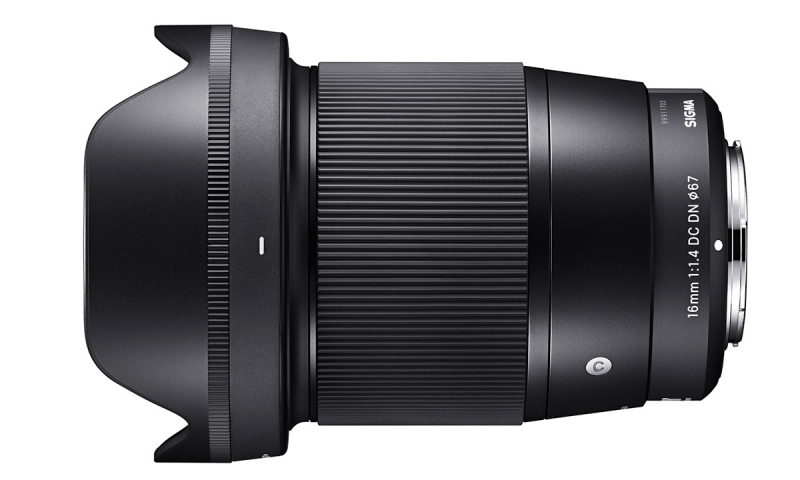
Again Sigma has produced a high-quality lens, and information technology's not even part of the visitor'south acclaimed Art serial. The Sigma 16mm F1.4 DC DN is office of the Contemporary lineup for APS-C and Micro Four Thirds arrangement cameras. Even though it isn't an Art lens, information technology performs on the same level—precipitous with first-class flare and ghost suppression and pleasing bokeh. I saw no noticeable chromatic aberrations or geometric distortion. Used with APS-C cameras, it covers the same angle of view as a 24mm lens on a full-frame body. On a Micro Four Thirds body, the bending of view matches that of a 32mm lens on full-frame camera.

© Ellis Vener
With a broad-bending 16mm lens, the potential distortion of almost-far spatial relationships tin spur creativity. At f/9 this exposure is crisp on the foreground and the mid-altitude signage.
The version Sigma made available for this review came in Sony E-Mount. I didn't have an a6500 available, so I did my test shooting with a full-frame Sony a7R Three body, which, equally soon every bit the lens was mounted, automatically switched to APS-C crop mode using merely the fundamental expanse of the sensor. This meant that the 42-megapixel a7R III became an 18-megapixel camera. Different full-frame DSLRs, Sony's electronic viewfinder enables the APS-C cropped composition to fill the viewfinder. The lens balances well on this body. On smaller bodies, information technology will experience larger but likely not too big or forepart-heavy. If you're a hymeneals photographer, hiker, or journalist and you're used to working with full-frame DSLR cameras and their lenses, you'll discover the lighter weight and smaller size of the lens and a mirrorless body refreshing.
© Ellis Vener
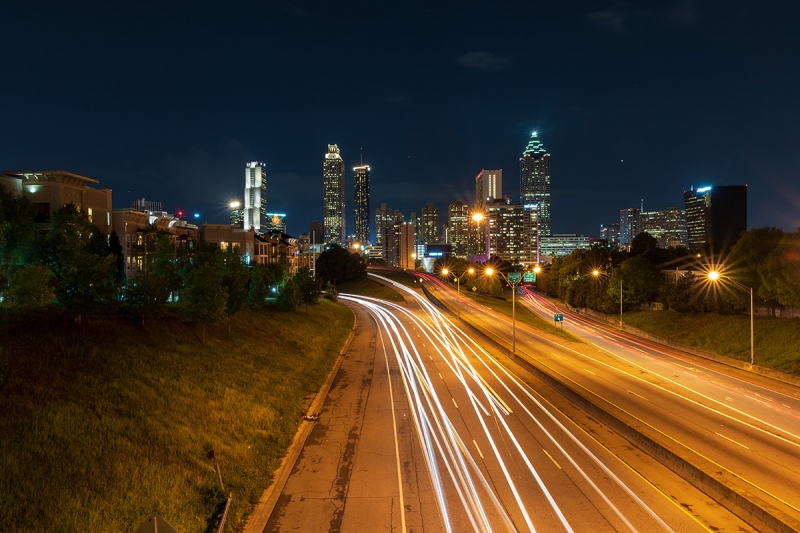
In this nighttime landscape there is an impressive corporeality of flare suppression and lack of internal reflections from signal-calorie-free sources. Resolution of fine compages detail was all-time in the f/iv to f/8 range.
I tested the lens in four scenarios: an environmental portrait, some functional compages, and 2 different skyline views, one during the day and the other at night. Information technology may seem non-intuitive to employ a wide-angle lens for portraits, but used advisedly, a broad-angle lens is a great choice for ecology portraits. You just have to be aware of how it may distort or emphasize almost-far spatial relationships and architectural elements. The lens' bokeh was pleasing at all apertures cheers to the size of the elements and the curved edges of the nine aperture blades. It's a 16mm lens, and so once you get down to f/xi and f/sixteen, it's difficult to find anything out of focus. In the night skyline I was impressed by the suppression of flare and lack of internal reflections from point light sources in the scene. Resolution of fine architectural details was best in the f/iv to f/eight range but was more than adequate when the lens was wide open up and at its minimum f/16 discontinuity.

© Ellis Vener
Wide-bending lenses can exist an fantabulous choice for environmental portraits when used carefully.
Externally the lens is 2.3 inches broad for much of its 3.6-inch length before tapering toward the lens mount. Near of the cylindrical body is covered by a ribbed transmission focus band and there are no switches and no focus distance indicator or scale. At fourteen.three ounces, the lens feels solid. Standard thread 67mm filters tin can be used, and a petal-shaped lens hood is included.
Internally the lens is made up of 16 elements in 13 groups. Ii of the lenses have aspheric shaped surfaces, three more are made from Sigma'south FLD drinking glass, and two are made from the company's SLD glass. FLD is Sigma'due south low-dispersion glass formulation, designated F in the model name, while SLD is short for special low-dispersion.
I have come to look keen things from Sigma Fine art lenses for DSLRs, and although this lens is in the smaller-format Gimmicky series, it has raw optical operation very nearly on par with the larger Art series. Its compact weight and size make information technology easy to shoot with. Manual focus was smooth every bit silk and responsive with naught lag. The 16mm f/1.iv DC DN C is notwithstanding another winning lens from Sigma, merely it doesn't quite compare with a total-frame 24mm f/1.iv lens on a full-frame camera. Sensor size and resolution have their advantages, merely for a $499 lens the performance-to-price ratio is impressive.
Ellis Vener is a contributing editor toProfessional Lensman.
Source: https://www.ppa.com/ppmag/articles/pro-review-sigma-16mm-f14-dc-dn-contemporary-lens

Post a Comment for "Sigma 16mm F/14 Dc Dn Contemporary Lens Review"